
Software Architecture
Nexent separates the web frontend, configuration management, agent runtime, MCP, northbound APIs, and data processing into independent services. These services collaborate through well-defined APIs and use PostgreSQL, Elasticsearch, Redis, and MinIO to store different types of data. The project provides both Docker Compose and Kubernetes deployment options.
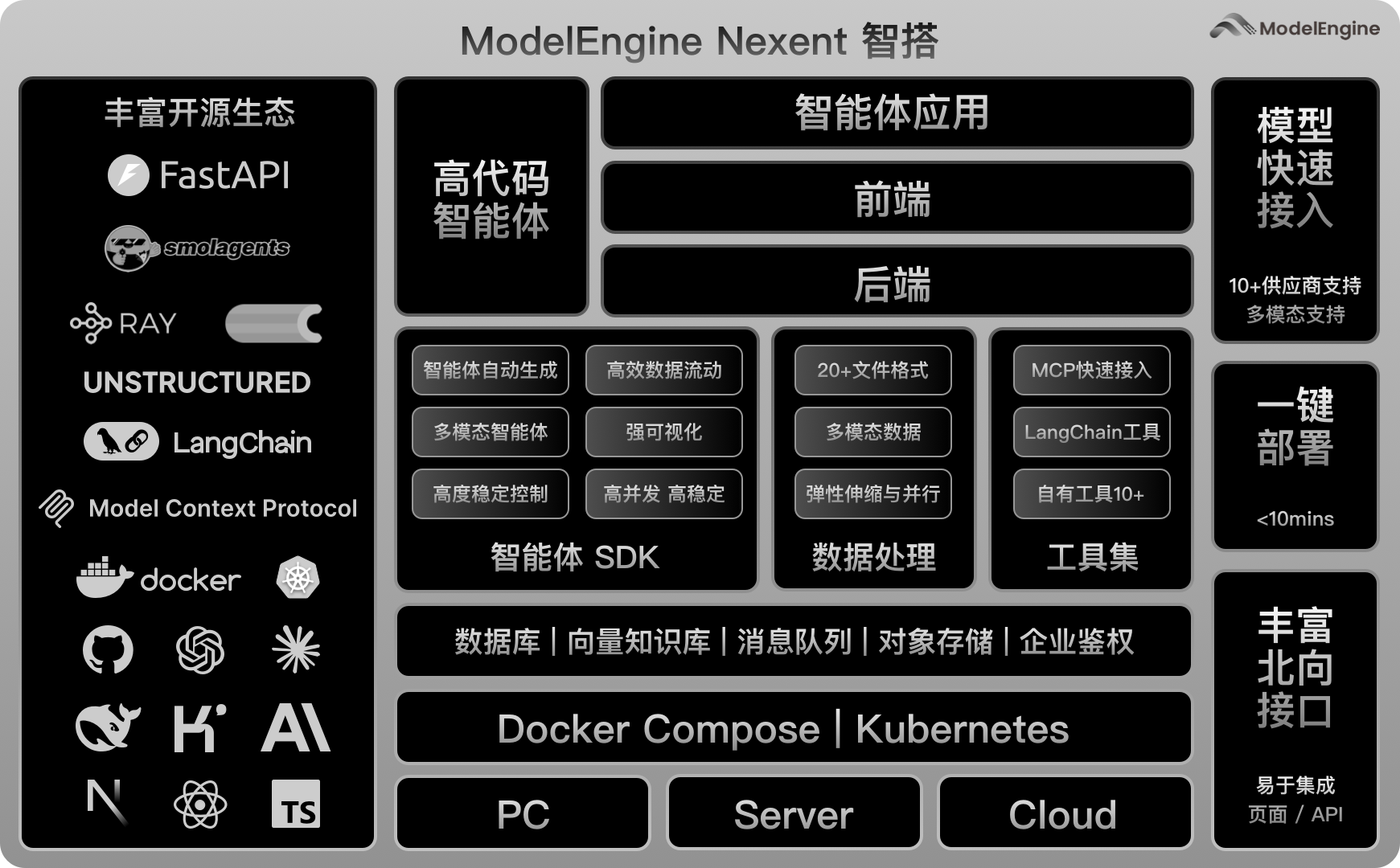
🏗️ Overall Architecture Design
Nexent's software architecture follows layered design principles, structured into the following core layers from top to bottom:
🌐 Frontend Layer
- Technology Stack: Next.js + React + TypeScript
- Functions: Agent generation and configuration, chat interaction, resource management, and multimodal file uploads
- Features: Responsive design, SSE streaming results, WebSocket voice communication, and internationalization (i18n)
🔌 API Gateway Layer
The backend consists of multiple FastAPI-based API services:
| Service | Port | Description |
|---|---|---|
| nexent-config | 5010 | Configuration API: agents, conversations, models, knowledge bases, memory, permissions, and resources |
| nexent-runtime | 5014 | Runtime API: agent execution, sandbox coordination, and streaming responses |
| nexent-mcp | 5011/5015 | MCP API and FastMCP service: MCP configuration, tool discovery, and container management |
| nexent-northbound | 5013 | Northbound API: external calls, conversation management, and A2A interfaces |
| nexent-data-process | 5012 | Data processing API: document parsing, chunking, vectorization, and indexing |
🧠 Business Logic Layer
The backend implements a clean layered architecture:
App Layer (backend/apps/)
- Purpose: HTTP boundary layer - parse/validate inputs, call services, map errors to HTTP
- Key Modules:
agent_app.py- Agent CRUD, version management, streaming executionconversation_management_app.py- Multi-turn dialogue, history trackingapi_key_app.py/quota_app.py- API key and capacity managementmodel_managment_app.py- Model configuration, health checksskill_app.py- Skill creation and managementknowledge_summary_app.py- Knowledge base operationsremote_mcp_app.py- Remote MCP tool managementa2a_client_app.py/a2a_server_app.py- A2A protocol support
Service Layer (backend/services/)
- Purpose: Core business logic orchestration, coordinate repositories/SDKs
- Key Modules:
agent_service.py- Agent lifecycle, configuration, and runtime request orchestrationruntime_proxy_service.py- Forward chat and debugging requests to the Runtime serviceagent_version_service.py- Version publishing, rollback, comparisonmodel_management_service.py/model_gateway_service.py- Model management and unified adaptationmemory_config_service.py- Memory configuration, context buildingconversation_management_service.py- Session management, history persistenceskill_service.py- Skill generation, template processingnl2agent_service.py- Natural-language agent generation conversations and draft managementdata_process_service.py- Document processing pipelinemcp_container_service.py- MCP container lifecycle managementremote_mcp_service.py- Remote MCP server integrationa2a_client_service.py/a2a_server_service.py- A2A agent communicationredis_service.py- Caching, distributed locks, session storage
Agent Core (backend/agents/)
- Purpose: Agent execution framework built on SmolAgents
- Key Components:
agent_run_manager.py- Agent run lifecycle, workspace management, and streaming coordinationcreate_agent_info.py- Agent configuration, tool, and sandbox environment builderpreprocess_manager.py- Document preprocessing orchestrationskill_creation_agent.py- LLM-powered skill generation
📊 Data Layer
Distributed data storage architecture with multiple specialized databases:
🗄️ Structured Data Storage
- PostgreSQL (port 5434): Primary relational database
- User and tenant management (
user_tenant_db.py) - Agent configuration and versions (
agent_db.py,agent_version_db.py) - Tool definitions and instances (
tool_db.py) - Conversation history (
conversation_db.py) - Group and permission management (
group_db.py,role_permission_db.py) - Memory configuration (
memory_config_db.py) - Skill definitions (
skill_db.py)
- User and tenant management (
- Features: ACID transactions, relation integrity, multi-tenancy support
🔍 Vector Search & Full-Text Search
- Elasticsearch (port 9210): Vector and full-text search engine
- Knowledge base storage (
knowledge_db.py) - Vector similarity search, hybrid search
- Semantic chunking and indexing
- Knowledge base storage (
- Features: Scalable search, relevance ranking, large-scale optimization
💾 Cache Layer
- Redis (port 6379): High-performance in-memory database
- Session caching
- Temporary data storage
- Distributed locks (
redis_service.py) - Celery task broker for async jobs
- Features: Sub-millisecond latency, persistence with AOF
📁 Object Storage
- MinIO (port 9010/9011): Distributed object storage
- File uploads and attachments (
attachment_db.py) - Document storage for knowledge base
- Preview files and sandbox-generated artifacts
- File uploads and attachments (
- Features: S3-compatible API, large file handling
The agent runtime also uses a separate workspace for the inputs and outputs of each run. Docker deployments share the workspace through the nexent-agent-workspace volume, while Kubernetes deployments use the nexent-workspace PVC. Artifacts that must be retained are synchronized to MinIO after a run, and the backend cleans up temporary working directories.
🔧 Core Service Architecture
🤖 Agent Services
Agent Framework (SmolAgents-based):
├── Agent Creation & Configuration
│   ├── NL2Agent requirement clarification and configuration generation
│   ├── Tool and Skill recommendation, installation, and binding
│   ├── Sub-agent relationship management
│   └── Version control and publishing
├── Agent Execution Engine
│   ├── Streaming response (SSE)
│   ├── Tool calling and orchestration
│   ├── Multi-model and multimodal input
│   └── Memory context building
├── Isolated Execution & File Processing
│   ├── Docker or other code sandbox levels
│   ├── Session or system lifecycle scope
│   ├── Isolated Skill script execution
│   └── Runtime workspace and MinIO artifact synchronization
├── Version Management
│   ├── Publishing and rollback
│   ├── Version comparison
│   └── A2A agent card registration
└── Lifecycle Management
    ├── Run registration and tracking
    ├── Stop and cleanup
    └── Preprocessing coordination
📈 Data Processing Services
Distributed Data Processing Pipeline:
├── Document Ingestion
│   ├── Multi-format support (20+ formats)
│   ├── PDF parsing with OCR
│   └── Table structure extraction
├── Chunking & Processing
│   ├── Semantic chunking algorithms
│   ├── Batch processing with Celery
│   └── Ray distributed computing
├── Vectorization & Indexing
│   ├── Embedding generation
│   ├── Elasticsearch indexing
│   └── Incremental updates
└── Preview Generation
    ├── PDF to preview conversion
    └── Image thumbnail generation
🌐 MCP Ecosystem
Model Context Protocol Integration:
├── Local MCP Service
│   ├── Stable built-in tools
│   └── Docker-based tool containers
├── Remote MCP Service
│   ├── Dynamic remote MCP server proxy
│   └── Outer API tool integration
├── MCP Container Management
│   ├── Container lifecycle (Docker)
│   ├── Log aggregation
│   └── Resource monitoring
└── FastMCP Server
    ├── Tool registration and discovery
    └── Standardized tool interfaces
🔄 A2A Protocol Support
Agent-to-Agent Communication:
├── A2A Client
│   ├── Agent card discovery
│   ├── Task submission and streaming
│   └── Response handling
├── A2A Server
│   ├── Agent card registration
│   ├── Task processing
│   └── Message streaming
└── Agent Adapter
    ├── Nexent ↔ A2A protocol translation
    └── Skill execution coordination
🚀 Distributed Architecture Features
⚡ Asynchronous Processing Architecture
- Foundation: asyncio-based high-performance async processing
- Task Queue: Celery + Redis for distributed task execution
- Computing Framework: Ray for distributed computing in data processing
- Stream Processing: Server-Sent Events (SSE) for real-time streaming
- Concurrency Control: Thread-safe concurrent processing mechanisms
🔄 Microservices Design
Service Decomposition Strategy:
├── nexent-config (5010)
│   └── Agent CRUD, configuration, user management
├── nexent-runtime (5014)
│   └── Agent execution, sandbox coordination, file artifacts, and streaming responses
├── nexent-mcp (5011/5015)
│   └── MCP tool protocol, container management
├── nexent-northbound (5013)
│   └── External APIs, A2A protocol, partner integration
├── nexent-data-process (5012)
│   └── Document processing, vectorization, Celery workers
├── nexent-web (3000)
│   └── Frontend Next.js application
├── nexent-sandbox (created according to the runtime strategy)
│   └── Isolated execution of model-generated code and Skill scripts
└── Optional Services
    ├── nexent-redis (6379) - Caching and message broker
    ├── nexent-elasticsearch (9210) - Vector search
    ├── nexent-postgresql (5434) - Relational data
    └── nexent-minio (9010) - Object storage
🌍 Containerized Deployment
Docker Compose Orchestration:
├── Application Services Containerization
├── Sandbox images and independent workspace volumes
├── Database Service Isolation
├── Network Layer Security (bridge network)
├── Volume Mounting for Data Persistence
├── Health Checks and Auto-restart
└── Corresponding Kubernetes Helm deployment option
🔐 Security and Scalability
🛡️ Security Architecture
- Authentication: Local accounts, OAuth, CAS, and northbound API keys
- Authorization: Role-based access control (RBAC) and user-group permissions
- Data Security: Tenant data isolation with sensitive configuration managed by backend services
- Runtime Isolation: Deployments use Docker sandboxes by default and restrict network access, shell access, CPU, memory, and per-step execution time
📈 Scalability Design
- Service Scaling: Configuration, runtime, northbound, and data-processing services can be deployed independently
- Resource Control: Compute resources can be configured separately for sandboxes and data-processing services
- Storage Scaling: MinIO stores objects, while Elasticsearch stores retrieval indexes
- Caching and Tasks: Redis provides caching, locks, and the Celery message broker
🔧 Modular Architecture
- Loose Coupling: Low inter-service dependencies, standardized interfaces
- Plugin Architecture: Hot-swappable tools and models
- Configuration Management: Environment-based configuration, dynamic updates
- Single Source of Truth: Environment variables centralized in
backend/consts/const.py
🔄 System Data Flow
📥 User Request Flow
User Input → Web Frontend → nexent-config or nexent-northbound
    → App Layer Validation → Service Layer Orchestration
    → Data Access (Database Layer) → PostgreSQL/Elasticsearch/Redis/MinIO
🤖 Agent Execution Flow
User Message → nexent-config / nexent-northbound
    → Runtime Proxy → nexent-runtime
    → Memory and Metadata Context Build → Tool and Sandbox Execution
    → Model Inference → SSE Streaming Response
    → File Artifact Synchronization → Final Conversation Persistence
📚 Knowledge Base Processing Flow
File Upload → nexent-config → nexent-data-process
    → Document Parsing → Chunking → Vectorization
    → Elasticsearch Index → Search Ready
⚡ Real-time Processing Flow
Real-time Input → Streaming Endpoint → Async Processing
    → SSE Stream → Frontend Display
🎯 Architecture Advantages
🏢 Enterprise-grade Features
- Deployability: Service decomposition, health checks, and automatic restart
- High Performance: Async processing, Redis caching, vector search optimization
- Concurrent Processing: Asynchronous APIs, task queues, and an independent Runtime service
- Monitoring Friendly: OpenTelemetry observability, Grafana Tempo tracing, structured logging
🔧 Developer Friendly
- Modular Development: Clean layered architecture (App → Service → Database)
- Standardized Interfaces: Unified API design with FastAPI
- Flexible Configuration: Environment-based configuration, hot-reload
- Easy Testing: Comprehensive test suites, dependency injection
🌱 Ecosystem Compatibility
- MCP Standard: Full Model Context Protocol implementation
- A2A Protocol: Agent-to-agent communication support
- Open Source Ecosystem: Integration with SmolAgents, FastMCP, LangChain
- Cloud Native: Docker Compose and Kubernetes deployment support
- Multi-model Support: Compatible with mainstream AI model providers
This architecture separates configuration management, agent execution, and data processing, allowing deployment scenarios to select components as needed while providing clear boundaries for tool extensibility, runtime isolation, and external-system integration.